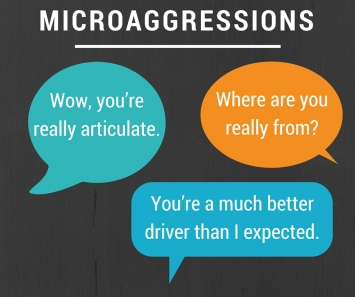
This is a preview to two special issues of the Journal of Cultural and Ethnic Minority Social Work of which I am the guest editor. The first of two is set to appear in January 2017. The first issue will be a double issue and will focus on theory and research. The second issue which will appear later in the year will focus on social work education. These special issues will then appear in a new book published by Taylor and Francis in late 2017.
What is a microaggression? The concept, first coined by Chester Pierce in the 1970s and brought to the forefront by Derald Wing Sue in the 2000s, refers to those everyday slights and insults, conscious or unconscious, intentional or unintentional, that demean or degrade individuals from disenfranchised groups. Personally, while the definition of microaggressions has been conceptualized much more broadly, I view it as something that is often perpetrated by good, often liberal-minded people whose words can carry more weight than the less common hateful bigot.
When we hear blatant and intentional racist, sexist, homophobic, or classist comments, whether it be on the streets or on the media, we can typically brush them off. Why? Because in my everyday life I don’t interact with people like this and most times know how to avoid them if I need to. But when they come from people who I trust, people I care about, people who I believe share my vision of a just society, it hurts and the pain tends to linger. Why? Because these comments don’t come out of individual ignorance or lack of tolerance. But rather, they come from social learning that originates from the deeply ingrained inequalities that exist within our structures and environment.
It is more than political correctness that I am talking about. It’s about hurting people, people we care about, even if we have the best of intentions. When a person talks about how they prefer to visit the outer islands rather than Honolulu when they travel annually to Hawaii, it is a simple comment. A comment that conveys a preference for a quieter vacation where they can connect with natural beauty. For me, however, it reminds me that people don’t want to see the realities of my homeland, how we work, how we live, and what’s good and what’s bad. They don’t want to be confronted with the homeless, interact with locals, or be made aware of the colonizing forces that we all contribute to. I don’t want to have to reflect on their comments in this manner, but I do. And sometimes, it hurts.
When I tell people that I grew up in a poor neighborhood in Hawaii, sometimes I am told, “I didn’t see any poor people when I went to Hawaii.” Rather than inquire further, they choose to invalidate my experience. Of course, they did not mean to, but it still happened. The sheer lack of awareness that the people who served them, while they were enjoying mai tais, don’t live in Waikiki with views of the ocean and likely make near minimum wage while living in a place with one of the highest costs of living in the U.S. does not occur to them in that moment. Clearly, they never made it to homeless villages near the Salvation Army in Palama or the west side beaches. This becomes even more evident when they tell me, “And all I ever saw were ABC stores!”
Now I must share that I myself am not free from perpetrating my own microaggressions. In fact, I probably have no awareness of number of microaggressions I commit on a daily basis, because they don’t affect me personally. Admittedly, it is difficult for me to even keep track of the conscious bigotry that has been taught to me and that is ingrained in me by society. And that is why I continue to research these issues; not only to make these issues aware to others who envision a just society, but as an ongoing reminder to myself.
See the full link below for my Guest Editorial to be published in January 2017.
microaggressions-and-social-work-practice
Photo borrowed from campusanswers.com


 Just Living 808