Listening with TING!

Listening…often times we hear, but how often do we listen.  Truly listen to what others are saying.  Most times, when we are in dialogue, especially with those with whom we disagree, we listen until we have a point to make.  Then we stop listening.

An example from my classroom.  A student who was white, female, and grew up in rural upper Michigan was sharing of a time when she showed compassion to a family who was African American when they were encountering racism.  She talked about how she was not exposed to diversity in her hometown, but knew what was happening was not right and made a stand.  In fact, given this was her first semester in Ann Arbor on the first day of class, her experience thus far had been the most diverse setting she had ever been in.

Unfortunately, in sharing her story, she used the term “colored people” to describe the African American family.  As soon as she said these words, there was a sudden groan in the class and nearly every person of color and white ally immediately raised their hand hoping I would interrupt her story and let them speak.  I knew quite well what was on their minds.  I could see the anger and frustration in their eyes.  They were triggered and wanted to make sure she knew this.  I did not call on anyone.  Rather, once she had stopped speaking, I calmly thanked this student for sharing her story, for acting as an ally in this situation, and welcomed her as a learner and someone new to diversity.  The looks of students in the class was that of stunned.  I paused and then said, I do want to let you know however that the term colored people is out of date and that the preferred term would be persons of color.  The student was embarrassed and apologetic and claimed she did not know.  She stated that she would do her best to learn this new term and not repeat the old term again.  I thanked and acknowledged her once again.  Slowly, the hands started to lower and though confused by what just happened, they allowed the class to continue.

In social justice education, many believe that what they say and the message that they deliver is what is most important.  How can we convince others that our vision of a socially just future is the right one?  I’d like to suggest that perhaps this can sometimes be a misguided approach and that the most important tool is to listen.  Truly listen.

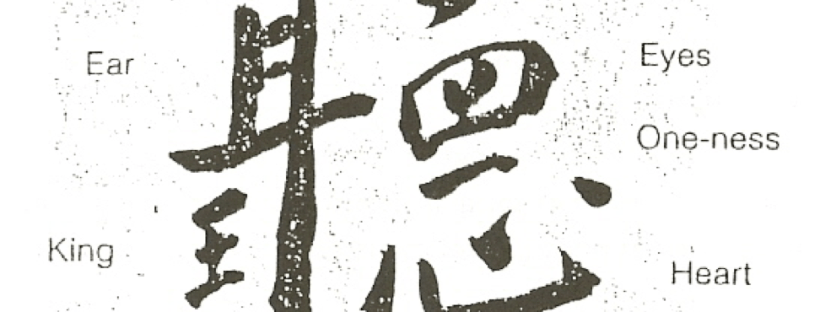
When we truly listen, what do we hear?  According to the ancient Chinese symbol for listen or “ting” which is embedded above (Huang-Nissen, 1999), listening consists of the following.  We listen with our ears. We listen with our eyes.  And we listen with our minds.  This is not so surprising.  We also listen with our heart, for the emotions that are being conveyed by the speaker.  But why king?  According to Huang-Nissen, when we listen, we should give the speaker the respect of royalty.  Why oneness?  We listen for the oneness of the message, for common ground.  We listen for some truth that we might have missed.  Something we can affirm, so that the speaker knows that we have truly heard them.  And the funny thing about this is, when we truly listen to others, they are more likely to hear us.
I am a Teacher and Learner

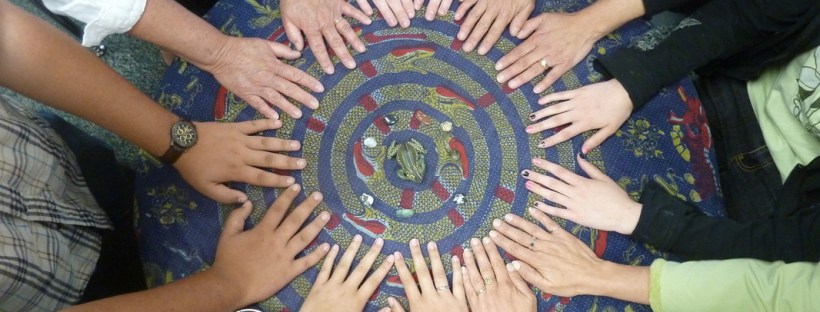
I typically begin every course I teach by asking participants to say their name, where they are from and to recite the words, “I am a teacher and a learner in this class.”  At first, people are quite reluctant to say these words and even somewhat embarrassed.  As we continue around the circle, some students appear to be more comfortable, while others rush through the words as if to put a period at the end of their sentence.  Others still sometimes forget to say the words, at which time I remind them to say the words with a smile.  As we get to the end of the circle, it is clear some find the exercise to be a bit corny, while others appear to have a lightbulb brighten above the heads as they ponder the implications of these words.  Once we have completed the circle, we debrief.

There are several reasons I ask participants to say these words.  First, these words are inspired by Paulo Freire, the Brazilian activist and educator involved in the critical pedagogy and popular education movements.  It presupposes that all participants offer something very valuable to the class and that we are more than passive learners.  It promotes a sense of egalitarianism and mutual respect for one another.  It also exemplifies the notion that none of us in the class hold the absolute truth and that through dialogue with one another, new knowledge will be created.  I, myself, recite these words as well, signifying that as the authoritative figure in the class, I too am open to learning and committed to democratizing and decolonizing the class.

I recall my first year in teaching, where I was so terrified that students might view me as incompetent and fraudulent as an instructor that I controlled every second in the class.  I lectured for 3 hours straight to avoid any questioning of the content and to demonstrate that I was the expert in the room.  I justified this by saying to myself that students needed this content to be successful social workers or that at the very least, they should get their moneys worth.  In fact, what I was really doing was promoting the hegemonic values of our western educational system. My students did not find the process very helpful and neither did I.

It wasn’t until I released the demons of academia that made me conform to its hierarchy and made me feel like I was not smart enough that I saw transformation within the classroom.  Student transformation occurred in the form of questioning, inquiry, and critical consciousness.  Rather than de-possessing students of their voice and reinforcing themes of passivity and ignorance through my own domination of the class, the process empowered participants to examine the social and political contradictions in our everyday thoughts, behaviors, and actions.

However, the greatest transformation in the classroom occurred within me.  By releasing the demons, I too became not just a teacher, but a learner.  This learning is most intense when I am confronted or questioned about the content, the classroom environment, or the structural inequalities that we support within our program.  It is not always pleasant and often quite uncomfortable, but my ability to sit through the discomfort, at my learning edge, is when I am most open to new learning and growth.  Step outside of your comfort zone and give it a try.

I am a teacher and a learner.